Locust
Grove is a National Historic Landmark on 55 acres
of the original 694 acre farm established by William
and Lucy Clark Croghan in 1790. William Croghan
was the brother-in-law and surveying partner of
George Rogers Clark, founder of Louisville and
Revolutionary War hero. George Rogers Clark spent
the last nine years of his life at Locust Grove,
from 1809 until his death in 1818.
Locust Grove also hosted three U.S. Presidents,
Monroe, Jackson and Taylor, and was a stopping
point for famed explorers Meriwether Lewis and
William Clark upon their return from their expedition
to the Pacific. In addition, Locust Grove was
home to numerous enslaved African-Americans who
lived and worked on the farm and contributed to
its success. Locust Grove tells the story of George
Rogers Clark, early Kentucky history, western
expansion and everyday life on the frontier.
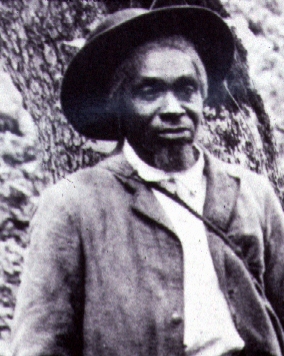
Above, portrait of George Rogers
Clark by Matthew Jouett courtesy of The Filson Historical
Society
Locust Grove is owned by Louisville
Metro Government and operated by Historic
Locust Grove, Inc.
Learn
more about Locust Grove

Locust
Grove is accredited by the American Association
of Museums.
Locust Grove is a National
Historic Landmark.
Join Our Mailing List!
Follow
us: 
Read our blog
.
|
    
Saving
Kentucky
Sally Van Winkle Campbell
With
a wine & cheese tasting
Wednesday, May 23
7:00 – 9:00 PM
Local author Sally Van Winkle Campbell presents
and signs her book on Kentucky’s culture
and heritage, Saving Kentucky: Greening the
Bluegrass. The book tells the stories of
the Kentuckians who are working to restore a healthy
environment and a rich cultural legacy of land,
people, and preserved historic structures. Featured
in the book are Kenny’s Cheeses and the
Smith-Berry Winery, who will present a wine and
cheese tasting for this event. Copies of Saving
Kentucky will be available for purchase.
Admission: $5/person, free for Friends of Locust
Grove.
Congratulations!
Preservation Kentucky presented its Excellence
in Preservation Education Award to Historic Locust
Grove Adviser, Edie
Bingham, at its annual meeting
April 13, 2012 in ceremonies held at Louisville’s
Whiskey Row Theatre and Gallery. Mrs. Bingham,
a long time historic preservation advocate known
throughout Kentucky for her support of significant
architecture and landscapes, joined the HLG Advisory
Council in 2010.
Rediscover
Locust Grove
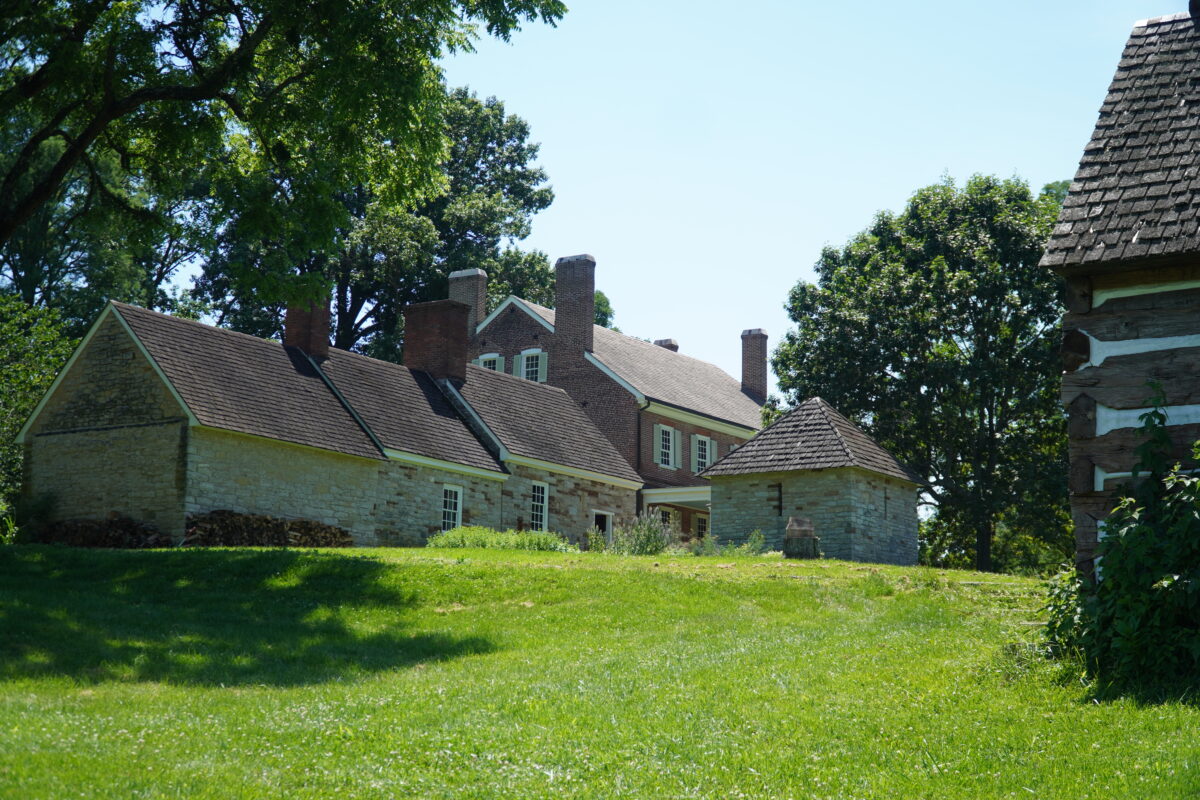
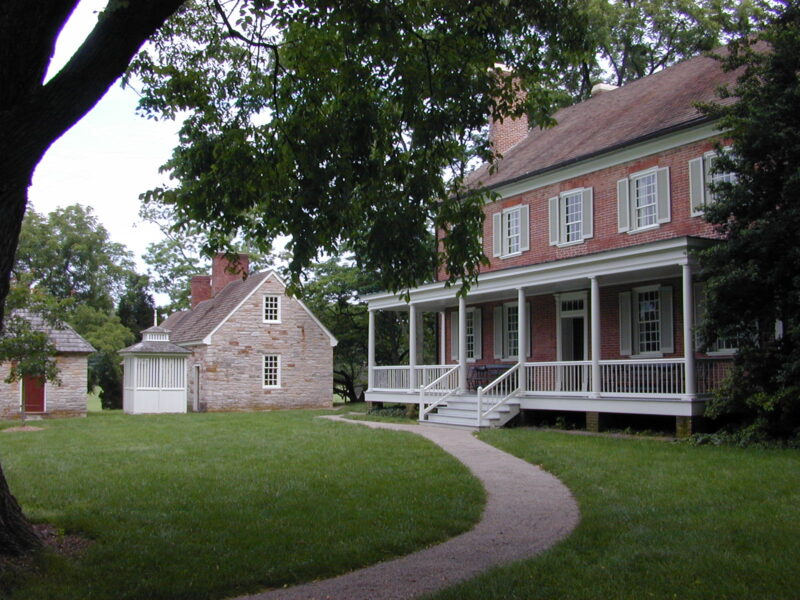
It's already spring on the beautiful 55-acre grounds
of Locust Grove, with gardens, historic stone
walls, fields, woods, and outbuildings such as
the wood shop, pictured above. The grounds are
open dawn to dusk, without charge.
The
main house at Locust Grove has undergone a complete
interior re-restoration over the past two years.
Based on new research in paint analysis and new
documentary findings, the early paint layers have
been reproduced and the house shines with verdigris,
glows with ochre and rose-colored paints, with
period wallpaper and carpeting in several rooms.
Originally restored and furnished in the 1960s,
this restoration includes a new look at room uses
and furnishings, and how the Croghans’ extended
household lived in the new nation.
A
significant feature of the restoration is the
custom wallpaper reprinted for Locust Grove by
Adelphi Wall Hangings: the French firm of Reveillon’s
Arabesque design, found in the House
and recreated as one of the most complex printing
jobs ever undertaken by Adelphi.
Tours
are offered every hour: 10:15; 11:15; 12:15; 1:15;
2:15 and 3:15 daily; Sunday at 1:15; 2:15 and
3:15.
Old
Soldiers, the Movie
See
this
clip from WHAS about a new film project involving
Locust Grove, featuring George Croghan as the
main character. "A group of local filmmakers
and actors who are also history buffs are out
to tell the story of Locust Grove and what took
place after the Revolutionary War generation passed
on. Casandre Medel, Brent Humes and Brian Cushing
came in to tell us about their latest project
and how you may be able to be part of this revealing
film which will release late in 2012." For
more information visit the project's Facebook
page "Old
Soldiers, The Movie."
Slave
Life at Locust Grove
New Exhibit Room
As part of a long-term effort to research and
present the life of the enslaved African-Americans
who lived and worked at Locust Grove, we have
designated the outbuilding known as the “Residence”
as a re-creation of a slave dwelling of the period
in the first decades of the 19th century when
the Croghans and George Rogers Clark lived at
Locust Grove.
This structure, a single room and loft, is the
center section of the outbuilding row directly
east of the main House, between the kitchen and
the smoke house. This room was probably NOT originally
used as a slave residence, but as either a residence
for an overseer or caretaker, or perhaps even
as the laundry for the site. However, in the absence
of an original or reconstructed slave house on
the site, using this room allows us to discuss
and interpret the living and working space of
an enslaved family.
We will present the space as the workroom of Locust
Grove’s seamstress and shoemaker, who would
use both the downstairs room (with a fireplace)
and the upstairs unheated loft.
The Slave Residence room itself will now be included
in all regular tours of the site.
Locust
Grove's permanent exhibit
This exhibit focuses on the interpretation of
the American Revolution in the West and the people
who settled and built this region. It includes
the surveying work of George Rogers Clark, Louisville’s
founder, and his brother-in-law, William Croghan,
who built Locust Grove,
including a recreated surveyors’ office
exhibit in the 1810 log building.
Other
sections of the exhibit look at the interactions
of the Croghan family and their enslaved workers
in the daily life of an early Kentucky farm.
Visit
the
Kentucky Tourism and the Derby
Region websites for more information about
visiting the area.
To add your name to our email
mailing list, send an email message to
Bonny Wise.
Let us know which events or programs you are most
interested in, or ask to receive all emails. This
gives you first notice and reminders of upcoming
events and programs, and cuts down on costs for
us. Thanks!
Links
to associated organizations & sites
Locust Grove's
Annual Report for
2011 is available as a .pdf file
|